
Scryer
exact mathematics for systems that guess.
Models are good at guessing what might be true. Scryer gives those guesses somewhere exact to land. It's a symbolic engine for research: it works over exact mathematical objects, derives what it can, and says where it gets stuck. Some results come with evidence you can replay.
why
A model can notice a pattern or choose a useful next question. Its confidence shouldn't do the algebra.
what exists now
It works with rationals and algebraic numbers, fields, polynomials, matrices, logic, graphs, optimisation, dynamics, and other domains.
Ask what follows from an object, or work backwards from laws to objects that satisfy them.
A generic construction space can reach the same mathematical object by different routes. That collision gives an identity to inspect.
Scryer can also search for candidate relations and counterexamples, and keep track of open conjectures.
a few outputs
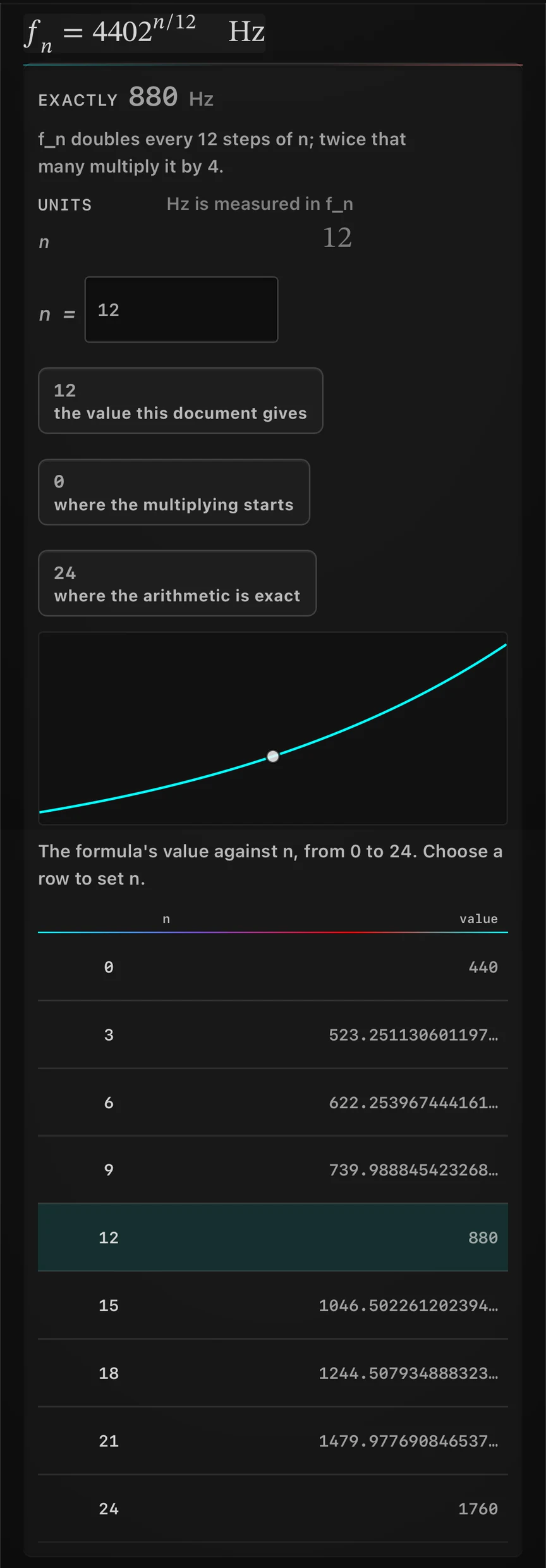
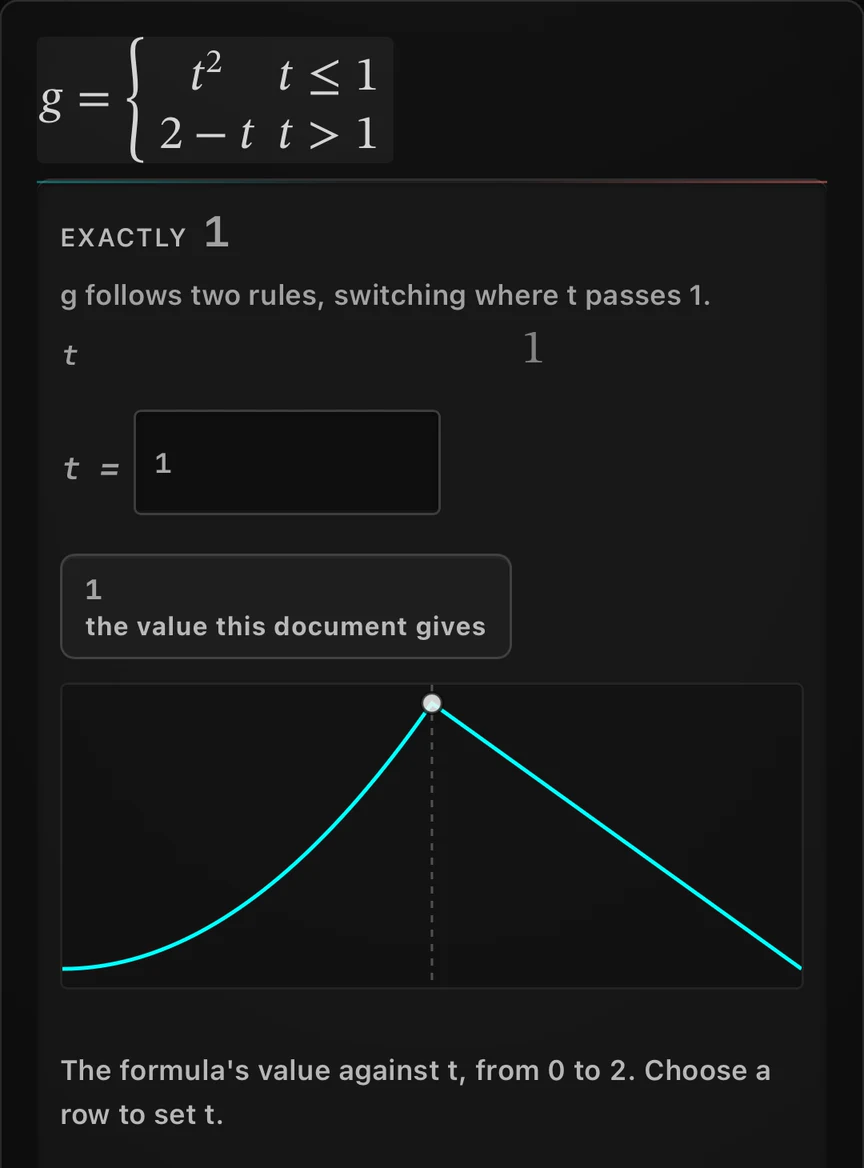
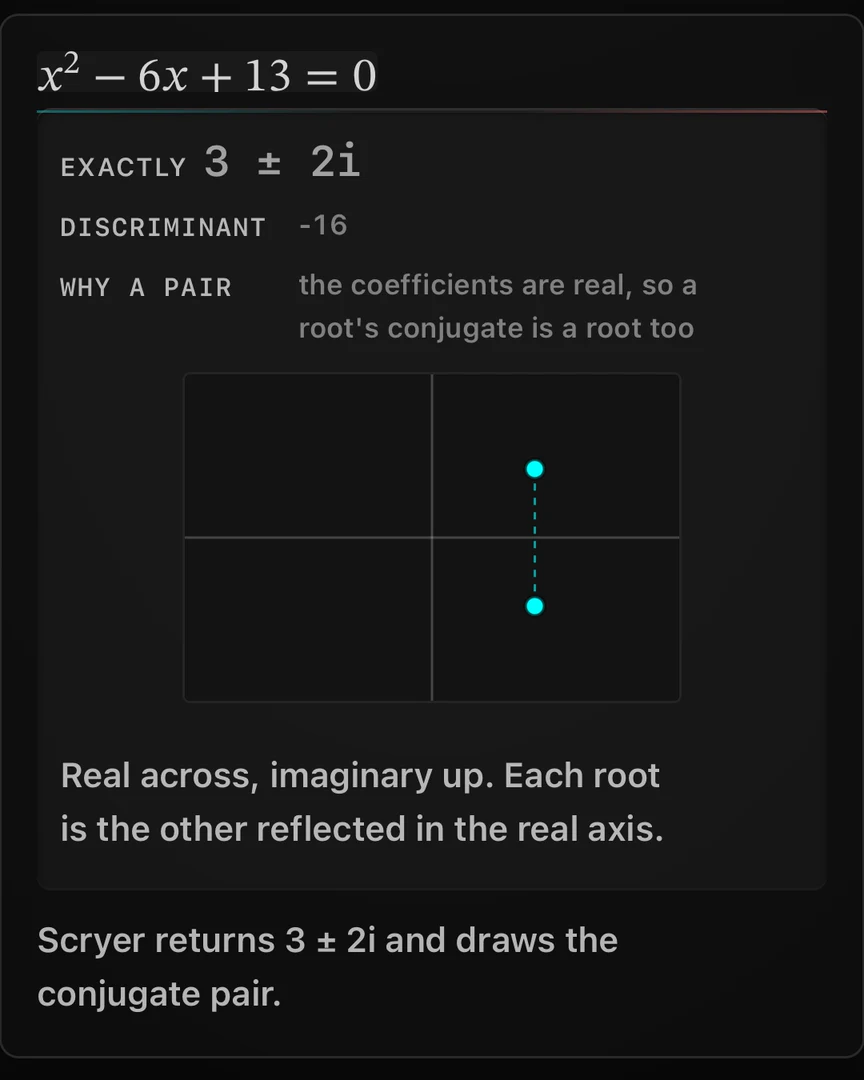
These screenshots come from an artifacting tool built on Scryer. The document supplied the equations; Scryer derived the details.
the important rule
Scryer can say no.
If it runs out of search budget, lacks the right representation, or needs mathematics it doesn't have, the result should say so. An unproved claim stays unproved.
An exact calculation can still start from faulty assumptions or answer the wrong question. Those limits should stay visible.
where it's headed
Verification came first. The work now is to let an agent build exact objects, search through them, and use what it finds to choose its next question.
A small proof and search system is testing that idea. Suggestions can steer the search. Only checked results are treated as facts; an open goal still shows what needs proving.
a tiny example of the idea
The search recovered the familiar identity √(3 + 2√2) = 1 + √2 when two constructions reached the same exact number.
use it
Public research access lets agents use Scryer through MCP tools.
underneath
The engine works with distinct mathematical structures that share arithmetic machinery. Each domain adds its own rules. Where implemented, certificates and proof DAGs make results replayable.
When one of those results looks odd, there's a trail to follow.